Columbia HVAC Co. is a family-owned heating contractor serving Columbia and Boone County. We repair and replace gas furnaces, electric furnaces, heat pumps, dual-fuel systems, ductless mini-splits and geothermal equipment — residential and commercial, every brand — and we answer emergency calls 24 hours a day with no extra fee for nights, weekends or holidays. On installations we pull the permit and file the rebate paperwork.
Heating is the heavier half of the year here. Columbia averages 5,024 heating degree days against 1,248 cooling degree days, with January at roughly 1,094, December at 1,010 and February at 857. The normal January low is near 21°F and we average 16.5 inches of snow a season. A heating system in mid-Missouri doesn't get an easy winter, and the equipment choice matters more than in a milder climate.
The heating work we do
| Service | What it covers |
|---|---|
| Furnace repair | No-heat calls, ignition and flame-sense faults, pressure switches, inducers, blower motors, control boards, electric furnace elements — 24/7 |
| Furnace installation | Right-sized gas and electric furnace replacement, venting, gas piping, condensate and the permit |
| Heat pump installation | Air-source heat pumps and dual-fuel pairings — the systems the city rebate pays the most for |
| Ductless mini-splits | Heating for additions, converted spaces, and older homes with no ductwork |
| Geothermal | Ground-source systems, with $1,200 city or $750-per-ton co-op rebate money in play |
| Maintenance plans | Annual service agreements — the fall inspection that prevents the January call |
| 24/7 emergency heat | Answered around the clock, no after-hours premium |
What Columbia actually heats with
The fuel mix here is genuinely split, and it drives every recommendation we make. Of the city's 52,564 occupied units, 53.9% (28,328) heat with natural gas and 43.4% (22,838) heat with electricity, with propane at 1.6%. Step outside the city limits and the picture changes: across the roughly 24,000 occupied units in the rest of Boone County it's about 35.7% natural gas, 43.5% electric and 17.8% propane — propane is roughly eleven times more common outside Columbia than inside it.
That matters because the right answer for a gas-heated ranch in Centralia, where 70.2% of homes use natural gas, is not the right answer for a propane-heated house in Harrisburg, where 46.2% of homes run on propane and natural gas service barely exists. Our post on converting from propane to a heat pump covers that second case in detail.
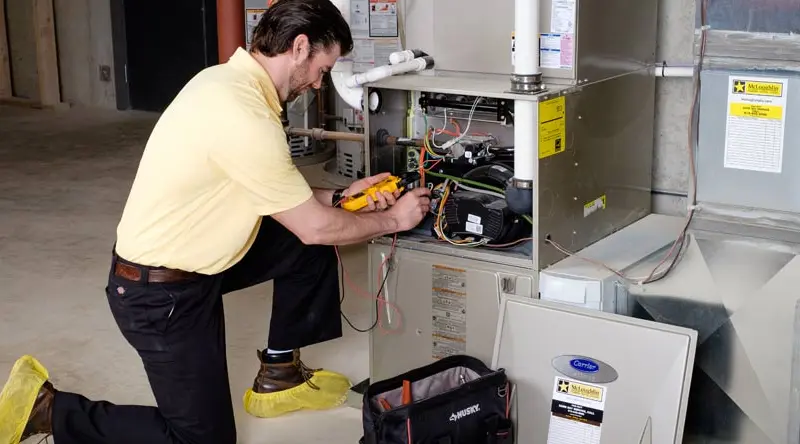
Which heating system is right for your home?
Gas furnace
Still the default for the gas-served majority of Columbia. Strong output on the coldest nights, well understood, and the replacement path of least resistance when you already have gas service, a flue and a working duct system. Efficiency ranges from 80% AFUE up through condensing models above 90%, which change the venting requirements.
Heat pump
One piece of equipment that heats and cools. For the 43.4% of Columbia homes already heating with electricity, a heat pump usually delivers the same heat for meaningfully less electricity than strip heat. It also collects the largest rebates the city offers. Modern cold-climate models hold capacity far better at low temperatures than the heat pumps people remember from the 1980s.
Dual-fuel (hybrid)
A heat pump paired with a gas furnace, switching to gas below a balance point we set for your house. With a normal January low near 21°F, Columbia sits right where that switchover logic earns its keep — the heat pump carries the long shoulder seasons, the furnace handles the cold snap. Our comparison of heat pumps versus furnaces in Columbia walks through the trade-off.
Ductless mini-split
For homes that never had ducts, additions, finished attics, sunrooms and converted garages. Common in the county's older housing — Rocheport's median home dates to 1938 and Sturgeon's to 1958, where duct chases often don't exist.
Geothermal
The highest efficiency available, using the ground's stable temperature instead of outdoor air. The upfront cost is real, but so is the rebate money: $1,200 from the city for units under 5 tons, or $750 per ton through Boone Electric for co-op members.
Boilers and radiators
A small number of older homes in and around Columbia still heat with a boiler and radiators or baseboard. If that's your system, call us and we'll tell you straight whether we're the right company for the work — we'd rather say so than take a job that should go to a hydronic specialist.
How a heating replacement goes
- We look at the whole house, not just the equipment. Size, insulation, windows, duct condition, existing fuel service, and what's actually wrong with the comfort today.
- We size the system properly. Replacing "whatever was there" is how homes end up with oversized equipment that short cycles, never dehumidifies and wears out early.
- You get options, in writing. Typically a straight replacement, an efficiency upgrade and a fuel-switch or dual-fuel option — each with the rebate it qualifies for.
- We pull the permit. On installations, that's our job, and the Columbia rebate packet depends on it.
- Installation. Correct venting, gas piping, electrical, condensate, refrigerant line sets, and duct connections that don't leak.
- Commissioning. Airflow, temperature rise, gas pressure, charge, and thermostat configuration — including the dual-fuel balance point when applicable.
- We file the rebate paperwork inside the six-month window, with the AHRI documentation and the final permit.
Rebates on heating equipment in Columbia and Boone County
Because Columbia runs its own utility, the rebate money here comes from the city rather than an investor-owned company. For City of Columbia Utilities electric customers:
| Equipment | Rebate |
|---|---|
| Heat pump, SEER2 15.2–18.1 | $800 |
| Heat pump, SEER2 18.2+ | $1,200 |
| Geothermal under 5 tons | $1,200 |
| Efficient Electrification — gas or propane → qualifying heat pump | $1,200 |
| Smart thermostat | up to $50 |
| Heat pump water heater | $500 |
Two rules decide whether you actually get the money: the application and receipts are due within six months of installation, and the packet requires a final mechanical permit. One more worth knowing — Efficient Electrification is a fuel-switching incentive, so if the system being replaced already contained a heat pump or an electric furnace, no rebate is available under that program. Full detail lives on our Columbia HVAC rebate guide.
Outside the city, Boone Electric Cooperative members have their own programs: $300 per dual-fuel system (minimum HSPF2 7.5, new installations, up to two per member) and $750 per ton on ground-source geothermal, both expiring 12/31/2026. Boone Electric serves all of Rocheport and all of Harrisburg among other areas — but don't guess: check the utility name on your bill. See Boone Electric rebates.
⚠️ The federal credits are gone for 2026
Both the 25C and 25D federal credits ended for property placed in service after December 31, 2025. If a heating quote still leans on a federal credit for a 2026 install, ask about it. What changed →
What affects the cost of heating work
- Equipment type and efficiency tier — single-stage, two-stage or variable-speed, and gas versus heat pump versus geothermal.
- Capacity, determined by a load calculation rather than by what was there before.
- Venting and fuel work. Moving from an 80% to a condensing furnace changes the venting; a fuel switch changes the electrical.
- Duct condition. New equipment on leaking, undersized ducts under-performs from day one.
- Electrical capacity for heat pumps and electric backup heat.
- Access and site conditions — attic, crawlspace, closet or basement.
- Rebates you qualify for, which come straight off the net cost.
We don't publish equipment prices, because a real number requires a real look at your house. What you get from us is an itemized written proposal, the rebate math included, and no pressure.
Serving Columbia and every town in Boone County
We work throughout the city and out into the county: Ashland, Hallsville, Centralia, Sturgeon, Harrisburg, Rocheport and Hartsburg, plus Columbia neighborhoods including Historic Old Southwest, East Campus, Benton-Stephens, the Grasslands, Shepard Boulevard, Vanderveen Crossing, Copperstone and Parkade. For the cooling half of the year, see our air conditioning contractor page, and for buildings rather than houses, commercial HVAC in Columbia.
Heating Contractor FAQs
What does a heating contractor do?
A heating contractor diagnoses and repairs heating equipment, sizes and installs replacement systems, maintains them seasonally, and handles the permit and paperwork that go with the work. For us in Columbia that covers gas and electric furnaces, heat pumps and dual-fuel systems, ductless mini-splits, geothermal, thermostats and the duct work that distributes the heat, on both residential and commercial buildings.
Should I put in a gas furnace or a heat pump in Columbia?
It depends on what fuel you already have, what the equipment costs to run for you, and whether you want the same unit to handle cooling. Columbia's normal January low is around 21°F, which sits right at the point where a standard air-source heat pump needs a backup heat strategy, so many homes here do best on a dual-fuel setup: a heat pump for most of the season with a gas furnace taking over in the coldest stretches. Homes already heating with electricity often gain the most from a heat pump, and switching from gas or propane can qualify for the $1,200 Efficient Electrification rebate from Columbia Water and Light.
How long does a furnace or heat pump last?
Service life varies with installation quality, maintenance and how hard the system runs. Columbia averages 5,024 heating degree days a year, so equipment here works for a living. Rather than quoting a single number, we look at the condition of your specific system: heat exchanger condition, refrigerant circuit, electrical components, airflow, and how many repairs it has needed recently. An annual inspection is what makes that assessment meaningful instead of a guess.
Do you pull the permit for a heating installation?
Yes. We pull the permit on installations and file the rebate paperwork. This matters in Columbia because the Columbia Water and Light rebate application requires a final mechanical permit as part of the packet, and the city's own guidance notes that these permits are usually obtained by the contractor. Unincorporated Boone County also requires a permit for HVAC installation or upgrade. For questions about a specific job, Columbia Building and Site Development can be reached at 573-874-7474 and Boone County Resource Management at 573-886-4330.
Do you work on propane heating systems?
Yes, and it is a bigger part of Boone County than most people realize. Inside Columbia only about 1.6 percent of homes use propane, but outside the city that figure is roughly 17.8 percent, and in Harrisburg it reaches 46.2 percent with almost no natural gas service available. We service propane furnaces and we handle propane-to-heat-pump conversions, which is a conversation worth having where propane delivery is the main heating cost.
Do you offer heating maintenance agreements?
Yes. We offer annual service agreements that cover seasonal inspection and maintenance of your heating and cooling equipment. The point of a fall heating inspection is simple: most of the failures that become 2am no-heat calls in January are visible in October, when a flame sensor is getting weak or an inducer is starting to fail.
Do you offer emergency heating service?
We answer the phone 24 hours a day, seven days a week, and we charge no extra fee for nights, weekends or holidays. A no-heat call in the middle of a January night is billed exactly like a Tuesday morning appointment.