A furnace replacement in Columbia should start with a heat-loss calculation and end with a filed permit. In between, the decisions that change your comfort and your gas bill are sizing, AFUE, staging and how the unit vents. We install gas furnaces across Columbia and Boone County, service every brand, and handle the permit and rebate paperwork.
Columbia is a gas-heating town: of 52,564 occupied housing units, 28,328 (53.9%) heat with natural gas. The median home here was built in 1993 and 17,817 units predate 1980, so many furnaces being replaced now sit in ductwork designed for something else entirely.
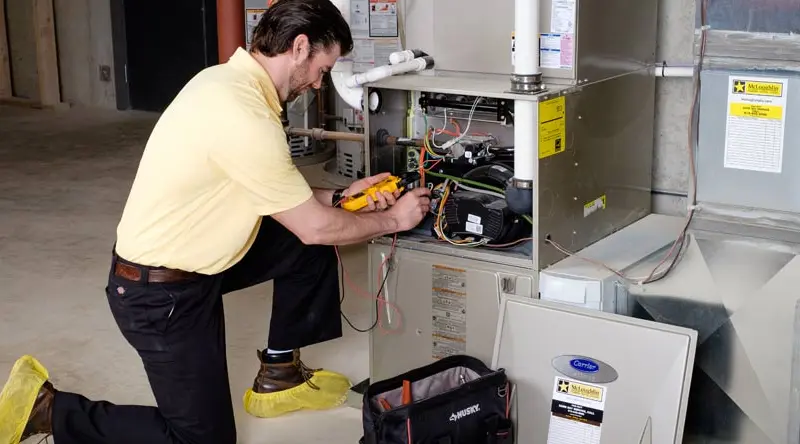
How do I know it's time to replace the furnace?
Age alone is not the trigger — the pattern of failures is. Replacement usually beats another repair when you see:
- A cracked heat exchanger — the one non-negotiable, because it is a combustion-safety issue
- Repeated repairs in one winter on a unit already past its expected life
- Parts no longer stocked — a discontinued control board can mean a week without heat
- Rooms that never catch up, meaning the furnace, the ducts or both were never matched to the house
- Short cycling, the classic signature of an oversized furnace installed as a same-size swap
On the fence? Read our breakdown of when to repair and when to replace an HVAC system. And if the furnace quits tonight, emergency furnace repair in Columbia is available around the clock at no extra charge.
What's included in a furnace installation?
A complete replacement is more than setting a new cabinet on the old pad:
- Heat-loss calculation for the actual house — square footage, windows, insulation, duct configuration
- Removal and disposal of the old furnace
- Gas connection, sediment trap and shutoff as code requires
- Venting — PVC sidewall for a condensing unit, a properly sized flue for an 80% AFUE unit
- Condensate drain and neutralizer where the equipment requires it
- Plenum and transition fabrication so the cabinet seals to your ductwork
- Combustion analysis, gas pressure check and airflow verification at startup
- The mechanical permit, filed and carried to final
What does the install day look like?
- In-home assessment — equipment, ductwork, vent path, electrical and drain options, then the load calculation.
- Proposal — the options that fit the house, trade-offs in plain terms.
- Permit filed before work begins.
- Installation — most straight replacements finish in a day, floors protected, old unit hauled away.
- Commissioning — gas pressure, temperature rise, static pressure and safety controls verified.
- Paperwork — permit to final, AHRI documentation, rebate filed inside the six-month window.
Which furnace should I choose?
Three variables matter more than brand: efficiency (AFUE), staging, and blower type.
| Option | What it means | Best fit in Columbia |
|---|---|---|
| 80% AFUE, single-stage | Vents through a metal flue; 80 cents of each fuel dollar becomes heat | Homes with no practical condensate drain or sidewall vent path |
| 90–96% AFUE, condensing | PVC sidewall venting, condensate drain required | The default for most Columbia homes at 5,024 HDD |
| Two-stage burner | Low fire most of the winter, high fire on the coldest days | Two-story homes and uneven room temperatures |
| Modulating, variable-speed ECM blower | Adjusts output continuously; quieter, steadier airflow | Larger homes; pairing with a high-efficiency A/C |
| Dual fuel (furnace + heat pump) | Heat pump in mild weather, furnace in deep cold | See heat pump installation |
One option worth raising: not installing a furnace at all. Columbia Water & Light pays $1,200 through Efficient Electrification when an existing home switches off gas or propane to a qualifying heat pump — money that does not exist on a gas-to-gas replacement. See heat pumps versus furnaces in Columbia.
Do I need a permit to replace a furnace in Columbia?
Yes. Columbia adopted the 2018 International Mechanical Code as Chapter 6, Article V of city code, and mechanical permits are filed through the city's EnerGov Citizen Self Service portal; unincorporated Boone County requires a building permit for HVAC installation or upgrade as well. We pull it either way — and it is not a formality, because Columbia Water & Light requires a final mechanical permit as part of a rebate application. The city notes those permits are usually obtained by the contractor. Property-specific questions go to Building and Site Development at 573-874-7474 or Boone County Resource Management at 573-886-4330; our guide to HVAC permits in Columbia covers the rest.
What rebates apply to a furnace replacement?
The city's residential rebate list does not include a gas furnace by itself — it rebates electric equipment and envelope work. Most furnace replacements still touch a line on it.
| Columbia Water & Light rebate | Amount |
|---|---|
| A/C or heat pump, SEER2 15.2–18.1 | $800 |
| A/C or heat pump, SEER2 18.2+ | $1,200 |
| Efficient Electrification — gas or propane to a qualifying heat pump | $1,200 |
| Smart thermostat | up to $50 |
| Duct insulation (to R-13 or better) | up to $300 |
Federal help is gone: the 25C and 25D energy tax credits both ended for property placed in service after December 31, 2025 under Public Law 119-21. Outside the city, Boone Electric Cooperative runs its own program — check the utility name on your bill and we will tell you which applies.
What affects the cost of a furnace installation?
We quote after seeing the house, because these move the number more than brand does:
- Heating capacity — the load calculation result, not the old nameplate
- Efficiency and staging — 80% single-stage versus a modulating condensing unit
- Venting changes — adding PVC sidewall venting or lining an existing flue
- Condensate handling — gravity drain, pump, or neutralizer
- Duct and plenum work — undersized returns are common in pre-1980 stock
- Access — a walk-in basement is a different job from a crawlspace or attic air handler
- Matched A/C replacement — more up front, less total labor
Where we install furnaces
The job looks different in each town. Centralia is the most gas-heated town we serve at 70.2%, median build year 1971 — prime replacement territory. Hallsville is 63.9% natural gas with 76.8% owner-occupancy. Sturgeon, median home built 1958, often needs duct work alongside the furnace. In Harrisburg, where 46.2% of homes run on propane and 4.3% on natural gas, it is a propane conversation. Related: A/C installation, air duct cleaning and annual maintenance plans.
Furnace Installation FAQs
How long does a furnace installation take?
A straight swap in an accessible basement or utility closet is usually a one-day job. Converting an 80 percent furnace to a condensing model that needs new PVC venting and a condensate drain, reworking an undersized return, or replacing the furnace and air conditioner together all add time.
What size furnace does my Columbia home need?
The size comes from a heat-loss calculation, not from the label on the old unit. We measure conditioned square footage, window area, insulation and duct configuration, then size to the actual load. Columbia averages 5,024 heating degree days a year with a normal January low near 21 degrees, and oversizing is still the most common mistake we find on replacements.
Is a 90 percent AFUE furnace worth it over an 80 percent model?
In most Columbia homes, yes, because AFUE is the share of fuel that becomes usable heat and the heating season here is long. The trade-off is installation: a condensing furnace vents through PVC to a sidewall and needs a condensate drain, so a home without a practical drain or vent path sometimes makes more sense with an 80 percent unit.
Is there a Columbia Water and Light rebate for a gas furnace?
Not for a gas furnace on its own. The city rebates electric equipment: $800 for an air conditioner or heat pump at SEER2 15.2 to 18.1, $1,200 at SEER2 18.2 or higher, $1,200 for geothermal under 5 tons, $1,200 for Efficient Electrification, and up to $50 for a smart thermostat. Replacing the air conditioner at the same time, or choosing a heat pump instead, puts rebate money back on the table.
Do you pull the permit for a furnace replacement?
Yes. Columbia adopted the 2018 International Mechanical Code as Chapter 6, Article V of city code, and permits are filed through the EnerGov Citizen Self Service portal. We file the mechanical permit and carry it to final, which also matters because Columbia Water and Light requires a final mechanical permit with a rebate application. Property-specific questions go to Building and Site Development at 573-874-7474.
Should I replace the air conditioner at the same time?
It is worth asking. The indoor blower serves both systems, so a new variable-speed furnace paired with an aging single-stage condenser cannot deliver what it is capable of. If the air conditioner is near the end of its life, doing both gives you a matched AHRI-listed system, one permit and one rebate application.