If your heat or your air conditioning quits outside normal business hours in Columbia, call (573) 204-6161. We answer around the clock, seven days a week, and — this is the part that matters — we do not add a fee for nights, weekends or holidays. The invoice for a 2am no-heat call on Christmas looks like the invoice for a Tuesday morning appointment.
We say that plainly because the fine print elsewhere often doesn't. It is common in this market for a company to promise "24-hour service" on the homepage while publishing Monday-through-Friday, 8-to-5 hours on the very same website, or to answer at midnight and then attach an after-hours premium to the bill. Both of those turn an emergency into a calculation: is it worth the surcharge, or do we put on another blanket and wait until Monday? That's a calculation nobody should have to run with a house at 48 degrees.
🚨 No heat or no cooling right now?
Call (573) 204-6161. Any hour, any day, no extra charge. If you smell gas or a CO alarm is sounding, get everyone outside first and call 911 from outside the building.
What counts as an HVAC emergency?
Not every problem needs a truck at midnight — but these do:
- No heat when it's freezing. Beyond comfort, this is a burst-pipe risk, especially in older homes with plumbing in exterior walls.
- No cooling during a heat stretch, particularly with infants, older adults, pets, or anyone with a heart or respiratory condition in the house.
- A carbon monoxide alarm sounding. Leave the building and call 911 first.
- A gas smell. Leave without touching switches, then call 911 and your gas utility from outside.
- Burning, electrical or hot-metal smells from the equipment, or a breaker that trips every time the system starts.
- Water pouring from an indoor unit, or a ceiling stain spreading under an attic air handler.
- Sparking, smoking or loud grinding from the outdoor unit — shut it off at the disconnect if you can do so safely.
- A commercial building or rental property losing conditioning, where tenants, customers, inventory or equipment are at stake.
Why Columbia has two emergency seasons
Most of the country has one. We have two, and the numbers show it. Columbia averages 5,024 heating degree days and 1,248 cooling degree days a year. January alone accounts for about 1,094 heating degree days with a normal low near 21°F, and we average 16.5 inches of snow a season. Then July and August deliver 382 and 350 cooling degree days against a normal July high close to 88°F. Equipment fails when it is asked to run continuously — which is exactly what happens during the first hard freeze and the first sustained run of mid-90s afternoons.
That's also why we staff for it instead of treating after-hours as an exception. Columbia's heating split — 53.9% natural gas and 43.4% electric — means emergency calls come in on gas furnaces, electric furnaces and heat pumps alike, and our technicians work on all of them.
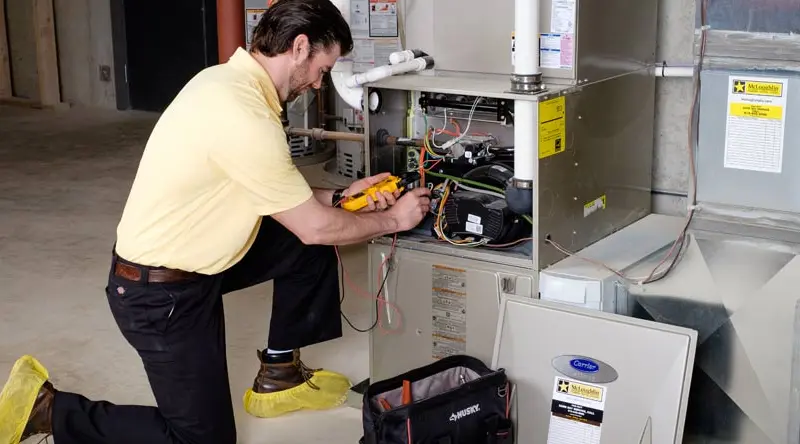
What happens when you call
- A person answers. Any hour. Tell us what the system is doing, what you've already checked, and whether anyone in the house is medically vulnerable.
- We triage over the phone. Some problems have a safe two-minute fix — a tripped switch, a thermostat in the wrong mode, a door interlock — and we'll walk you through those before dispatching anyone.
- We give you an honest arrival window, including when other emergencies are already open. We'd rather tell you the truth than keep you waiting on a promise.
- Diagnosis on arrival. We find the actual failure rather than guessing at a part.
- You get the price before the work. Same pricing as a weekday visit, with no after-hours multiplier hidden in it.
- We get you running, or we get you safe. If the right part isn't available at 3am, we'll do what can be done to hold the house and come back with it.
Before we arrive: safe things you can check
- Thermostat — correct mode, setpoint above (or below) room temperature, fresh batteries.
- Power — the breaker for the furnace or air handler, the outdoor disconnect, and the switch that looks like a light switch beside the furnace.
- Filter — a completely clogged filter causes both no-heat lockouts and frozen A/C coils.
- Blower door — if it isn't fully seated, the safety switch keeps the furnace off.
- If the A/C is iced — cooling OFF, fan ON, and let it thaw.
- If there's no heat and it's below freezing — open cabinet doors under sinks on exterior walls, let a faucet drip, and close off unused rooms. Keep any space heater well clear of bedding, curtains and furniture, and never use a cooktop or oven for heat.
One thing not to do: don't keep resetting a furnace that locks out repeatedly. Repeated ignition attempts on a system with a venting or combustion problem is exactly the situation the lockout exists to prevent.
Emergency service for businesses, landlords and property managers
Columbia is 48.7% owner-occupied, which means roughly half of the households here are renting — about 27,000 of them. A Sunday-night no-heat call is very often a tenant call, and the response has to be fast whether or not it's convenient. We handle residential and commercial work, so restaurants, offices, clinics, shops and multi-unit properties get the same around-the-clock coverage with no after-hours premium. See our commercial HVAC page and our property management HVAC services for how we set that up in advance — response expectations, unit inventories and scheduled turnovers all work better arranged before the emergency.
When the emergency turns into a replacement
Sometimes the honest answer at 11pm is that the equipment is finished. If that happens, we'll stabilize what we can and give you a real comparison in daylight — and in Columbia the replacement math includes rebate money. City of Columbia Utilities electric customers can claim $800 from Columbia Water & Light on a replacement air conditioner or heat pump at SEER2 15.2–18.1, $1,200 at SEER2 18.2+, $1,200 for geothermal under 5 tons, and $1,200 through the Efficient Electrification program when a gas or propane system is replaced with a qualifying heat pump. Rebates are for replacements only, the application is due within six months, and it requires a final mechanical permit — we pull the permit and file the paperwork. Start with our Columbia HVAC rebate guide, or Boone Electric rebates if you're outside the city, and our post on repairing versus replacing an HVAC system if you want to think it through beforehand.
What affects the cost of an emergency call
The same things that affect any service call — except the hour of the day:
- What failed and what the repair involves.
- Parts availability at that moment; common failure parts ride on the truck, model-specific boards sometimes don't.
- Access to the equipment — attic, crawlspace, rooftop or mechanical closet.
- Residential or commercial equipment, which differ in scope and componentry.
- Whether you're on a service agreement. Our annual maintenance plans catch the failures that would otherwise become 2am calls.
What never affects it: the clock or the calendar. We don't publish flat prices for repairs, because a number quoted before anyone has seen your system isn't honest — but we do commit that the number won't go up because it's Saturday.
Emergency HVAC across Columbia and Boone County
We respond throughout the county: Ashland, Hallsville, Centralia, Sturgeon, Harrisburg, Rocheport and Hartsburg, plus every Columbia neighborhood from Historic Old Southwest to Vanderveen Crossing. Whatever quit, we work on it: furnace repair, air conditioning repair, heat pumps, ductless systems and commercial equipment — all brands, whether or not we installed it.
Emergency HVAC FAQs
Do you really charge no extra fee for nights, weekends and holidays?
Yes. There is no after-hours rate, no weekend rate and no holiday rate on our invoices. A no-heat call at 1am on New Year's Day is handled and billed the same way as an appointment on a Tuesday morning. It is worth asking any contractor this question directly before they dispatch, because an advertised 24-hour phone line and a flat after-hours rate are two different promises.
What counts as an HVAC emergency?
No heat in freezing weather, no cooling during a heat stretch, a carbon monoxide alarm, a burning or electrical smell from the equipment, water pouring from an indoor unit, an outdoor unit that is smoking or sparking, and any heat or cooling loss in a home with infants, older adults or anyone whose health depends on a stable indoor temperature. Commercial buildings and rental properties add tenant safety and inventory to that list. If you are unsure, call and we will help you judge it.
How fast can you get here?
We dispatch as quickly as we can and we will tell you an honest window when you call rather than a number designed to keep you on the phone. Travel time varies with where you are in Boone County and how many emergencies are already open, which in Columbia usually means the first hard freeze and the first stretch of mid-90s afternoons are the busiest hours of the year.
What should I do if I smell gas?
Do not use light switches, appliances or your phone inside the building. Leave immediately, take everyone with you, and once you are outside and away from the structure call 911 and your gas utility's emergency line. Do not go back in to shut anything off. Call us after the gas side has been made safe and we will handle the equipment.
My carbon monoxide alarm went off. What now?
Get everyone outside into fresh air and call 911. Do not try to find the source yourself, and do not reset the alarm and go back to bed. Once the fire department has cleared the building, a combustion appliance needs to be inspected before it is put back in service. We will check the furnace, the venting and the combustion air supply, and we will not relight equipment that is not safe to run.
Can I do anything before the technician arrives?
A few safe checks help. Confirm the thermostat is set correctly and has good batteries, check that the breaker and the furnace switch are on, and look at the filter. If the system is frozen, turn cooling off and the fan to ON. In a no-heat situation, close off unused rooms, open cabinet doors under sinks on exterior walls to protect pipes, and keep space heaters away from anything combustible. Do not repeatedly reset equipment that keeps locking out.
Do you handle emergency calls for businesses and rental properties?
Yes. We are a residential and commercial contractor, and after-hours calls from landlords, property managers and business owners are a regular part of what we do. With roughly half of Columbia households renting, a no-heat call on a Sunday is often a tenant issue rather than an owner-occupied one, and it gets the same response and the same no-extra-fee billing.