If your home heats with electricity or propane, a heat pump is almost always the upgrade. If it heats with natural gas — as 53.9% of Columbia homes do — the honest answer is usually neither one alone but dual fuel: a heat pump for most of the season with the furnace as the cold-weather stage. Columbia's normal January low sits near 21°F, which is precisely where a standard air-source heat pump needs a backup-heat plan.
How cold does it actually get here?
Cold enough to matter, not cold enough to disqualify a heat pump. The numbers from Columbia Regional Airport:
| Columbia climate normal | Value |
|---|---|
| Heating degree days per year | 5,024 |
| Cooling degree days per year | 1,248 |
| Normal January low | about 21°F |
| Normal July high | about 88°F |
| Average annual snowfall | 16.5 in |
Read those two degree-day totals together and you have the real story: Columbia is a genuine dual-load market with two demanding seasons. Whatever you install has to be good at both — which is one reason a heat pump, an air conditioner that runs backwards in winter, gets a serious look here.
What is dual fuel, and why does it fit Columbia?
A dual-fuel system is a heat pump and a gas or propane furnace in the same house, sharing the same ductwork and thermostat. The heat pump carries the load through the 35–55°F weather that makes up most of a Missouri heating season. Below a switchover point you set, the furnace takes over and delivers full output on the nights that actually test the house.
The alternative — a heat pump with electric resistance backup — works, but resistance heat is the expensive way to make BTUs. If a furnace is already in the basement and the ducts are sound, dual fuel is usually the better engineering answer in Columbia. What matters is that the switchover point is set deliberately for your home and your rates, not left wherever the controls shipped.
Not Sure Which Way to Go?
We'll size the load, look at what's already in the basement and lay out the furnace, heat pump and dual-fuel options with the rebate figured in.
What heats Columbia homes today?
| Heating fuel | Columbia occupied units | Share |
|---|---|---|
| Natural gas | 28,328 | 53.9% |
| Electricity | 22,838 | 43.4% |
| Propane (LP) | 834 | 1.6% |
That split is unusually balanced, and it explains why both arguments have loud advocates in this town. It also varies sharply by community: Centralia runs 70.2% natural gas, Hallsville 63.9%, while Harrisburg is 46.2% propane with only 4.3% on natural gas. Where you live changes the answer.
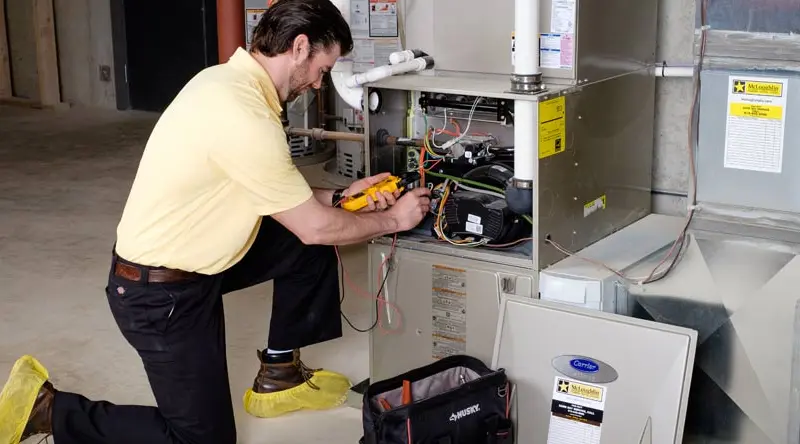
Which one does Columbia Water & Light pay more for?
The SEER2 tiers are identical for an air conditioner and a heat pump: $800 at SEER2 15.2–18.1 and $1,200 at 18.2 and above, on a replacement, for City of Columbia Utilities electric customers. The difference is what a heat pump can add on top.
Only a heat pump can qualify for the separate $1,200 Efficient Electrification rebate, which pays homes moving off gas or propane. A straight air conditioner can never earn it. So if your air conditioner is due anyway and you heat with gas, choosing a heat pump instead of an A/C is the only path to the larger rebate total — and it converts your existing furnace into the backup stage of a dual-fuel system in the process.
One exclusion to know: if the system being replaced already contained a heat pump or an electric furnace, no Efficient Electrification rebate is available. Our rebate walkthrough covers the packet, the AHRI requirement and the six-month deadline.
When does a furnace still win?
Plenty of times. When the existing air conditioner is young and only the furnace has failed, replacing just the furnace is the clean move. When the ductwork can't carry the higher air volume a heat pump prefers and there's no appetite to modify it. When the home is on the coldest end of the county and the owner wants the simplicity of one fuel. And when the electrical service can't accommodate a heat pump's requirements without an upgrade nobody budgeted for.
A well-maintained gas furnace is not an embarrassment. If yours is serviceable, furnace repair and an annual maintenance plan will get more life out of it than a rushed replacement will.
What about geothermal?
A ground-source system sidesteps the cold-weather question entirely, because it draws from soil temperature instead of outdoor air — no backup stage, no switchover point. The trade is a ground loop and the yard access to install it. Geothermal under 5 tons earns the $1,200 city rebate; outside the city, Boone Electric pays $750 per ton on ground-source, and $300 per dual-fuel system, both expiring 12/31/2026. Check the utility name on your bill to know which applies.
⚠️ The federal credits are gone
The federal 25C and 25D tax credits both ended for property placed in service after December 31, 2025, under Public Law 119-21 — including the geothermal credit. Any heat-pump quote leaning on a 2026 federal credit is quoting something that no longer exists. What changed →
Frequently asked questions
Do heat pumps work in Columbia, Missouri winters?
Yes, with a backup-heat strategy. Columbia's normal January low is about 21°F, which sits right at the point where a standard air-source heat pump loses capacity and needs help. That is why most Columbia installations are dual fuel or are specified with a clearly defined switchover point rather than left to run on resistance backup.
What is a dual-fuel system?
A dual-fuel system pairs an electric heat pump with a gas or propane furnace in the same home. The heat pump handles mild and moderate weather, and when the outdoor temperature falls below a set switchover point the furnace takes over. You get heat-pump efficiency through most of the season and full furnace output on the coldest nights.
Does Columbia Water and Light pay more for a heat pump than an air conditioner?
The SEER2 tiers are the same for both, at $800 for 15.2 to 18.1 and $1,200 for 18.2 and above. The difference is that only a heat pump can qualify for the separate $1,200 Efficient Electrification rebate, which pays homes switching off gas or propane. An air conditioner can never earn that one.
How many Columbia homes heat with gas versus electricity?
Of Columbia's 52,564 occupied housing units, 28,328 or 53.9% heat with natural gas and 22,838 or 43.4% heat with electricity. Another 834 units, about 1.6%, use propane. Both the gas-furnace market and the electric and heat-pump market are large here.
Is a heat pump worth it if I already have a gas furnace?
Often yes, when the air conditioner is due for replacement anyway. Swapping the condenser for a heat pump instead of a straight air conditioner turns the existing furnace into the backup stage of a dual-fuel system, and it opens the door to the Efficient Electrification rebate that an air conditioner cannot claim.
Will a heat pump raise my electric bill?
Your electric use will go up because heating load moves onto the electric meter, and your gas or propane use goes down correspondingly. Whether the total is lower depends on the home, the equipment and the switchover point, which is why the switchover setting is worth getting right rather than leaving at a factory default.